Portfolio
Below are a few recent achievements, professional and personal, which will surely impress!
Ask a Citizen
After I joined Citizens Bank as the Head of SEO (Search Engine Optimization), an avalanche of competitors descended upon us. Companies like NerdWallet, ValuePenguin, The Balance, and many more began to dominate the SERPs, and banks like Citizens were crowded out. In 2010, banks could easily rank on keywords like “what is a HELOC?” but by 2016, only two or three banks – the big nationals – might be visible on the first page of the SERPs.
At the same time, Google was moving more and more towards a question and answer format. The “people also ask” feature became ever-present, addressing the true essence of a query: the search for an answer.
We needed to do something that would increase our visibility, content volume, and make it easier for our customers to find the right answer quickly and with as little friction as possible.
So I successfully pitched Ask a Citizen.
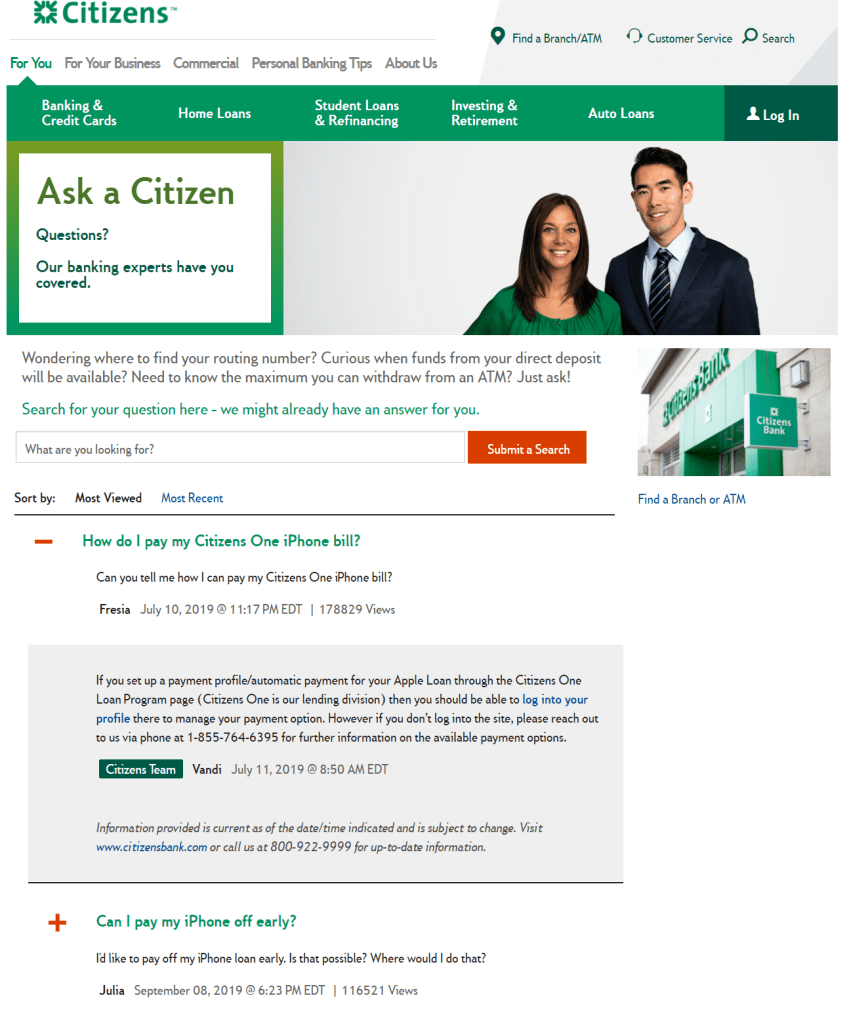
Ask a Citizen is a place for customers to get answers quickly to questions that others had asked before them. And if an answer isn’t available, a customer can email one of Citizens’ chat agents and get an emailed response within a business day. It enabled another channel for customer outreach – email – where you could just fire off your non-urgent question and leave your device to do other things, unlike chat or a phone call.
Growth was nearly immediate, mostly because it catered to branded search keywords like “citizens bank wire transfer” and the like. In two years, I created 1,300 pages of content. Ask a Citizen became one of the top site sections on the website within 8 months.
Besides a boost in organic search traffic, I estimate that Ask a Citizen saves the bank several million annually in avoided calls to the Contact Center:
[Visits] X [Average Cost per Call] X [Answer Likelihood to Make a Call Unnecessary] = ~$4 million per year.
Overall, a big, big win.
Onsite Search
Like many companies, Citizens’ onsite search function was not allocated many management resources, so when Yext presented their new onsite search solution at the 2019 Innovation Summit, I was all ears. We had already implemented branch pages with Yext, so as a trusted partner, it was an easier sell to get approval for their Answers implementation.
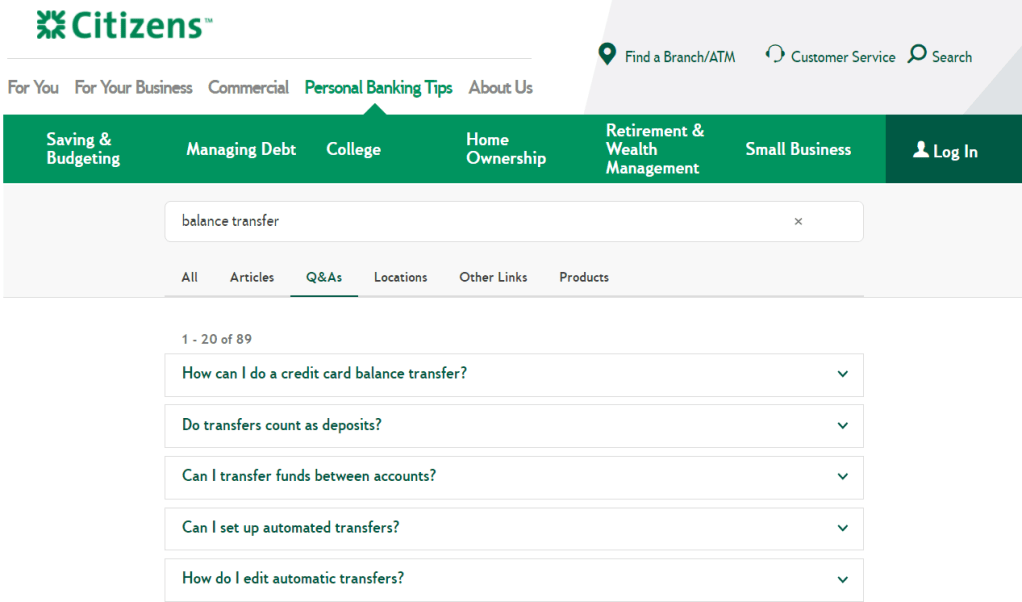
The implementation was a natural fit for the content from Ask a Citizen, in fact, which taught us how popular Q&A content could be. After importing the Ask a Citizen Q&As into Yext Answers, in fact, it quickly accounted for 65% of all interactions (clicks on a link or a click on a dropdown).
Further, app start conversion rate, measured by application divided by interactions with Answers content, almost doubled.
Catching Quarters (Coin Snatching)
My friend didn’t believe me at happy hour when I bragged about how humbly informed him I could do this trick, often called “coin snatching,” so I made a video and sent it to him.
Patents at Yahoo!
Say no more, exclaimed my inner voice when Yahoo! informed its employees that it would pay up to $2,000 for each submitted patent application, I’ve got lots of ideas. Five applications later, I had some money in the bank and a handful of years after that, I became the official inventor of three U.S. patents.
- Search pogo-sticking benchmarks
“Disclosed are apparatus and methods for quantifying how much searchers select other search results, instead of a particular search result. In example embodiments, the number of times that other search results are selected before a particular search result is selected (referred to as pre-pogo-sticking) is tracked, and the number of times that other search results are selected after a particular search result is selected (referred to as post-pogo-sticking) is also tracked. This pogo-sticking information may be used to improve search result ranking as produced by a search algorithm or to provide metrics to potential or current buyers of particular search terms.” - Time-based analysis of related keyword searching
“Disclosed are apparatus and methods for displaying related search terms in a time sequence format. In example embodiments, a user search database, for retaining search terms that were used during specific times, may be available. The user search database may be searched to find which users have searched on a selected anchor term. The frequency of use of such anchor term may then be displayed in a time sequence format, e.g., over a week time period. The users that have used this selected anchor term may have also searched on other search terms, and the search terms that belong to a selected category of interest and were also used by the anchor term users may also be located in the user search database. These search terms from the selected category may also be displayed in a time sequence format, e.g., in the month preceding or proceeding the anchor use display’s time period.” - Apparatus and methods for providing search benchmarks
“Disclosed are apparatus and methods for quantifying how much searchers select other search results, instead of a particular search result. In example embodiments, the number of times that other search results are selected before a particular search result is selected (referred to as pre-pogo-sticking) is tracked, and the number of times that other search results are selected after a particular search result is selected (referred to as post-pogo-sticking) is also tracked. This pogo-sticking information may be used to improve search result ranking as produced by a search algorithm or to provide metrics to potential or current buyers of particular search terms.”
Yahoo! recognized my innovations with a “Patent Filing Milestone” award in the form of a nifty glass cube.
Acknowledgement in “The Secret Lives of Monks”
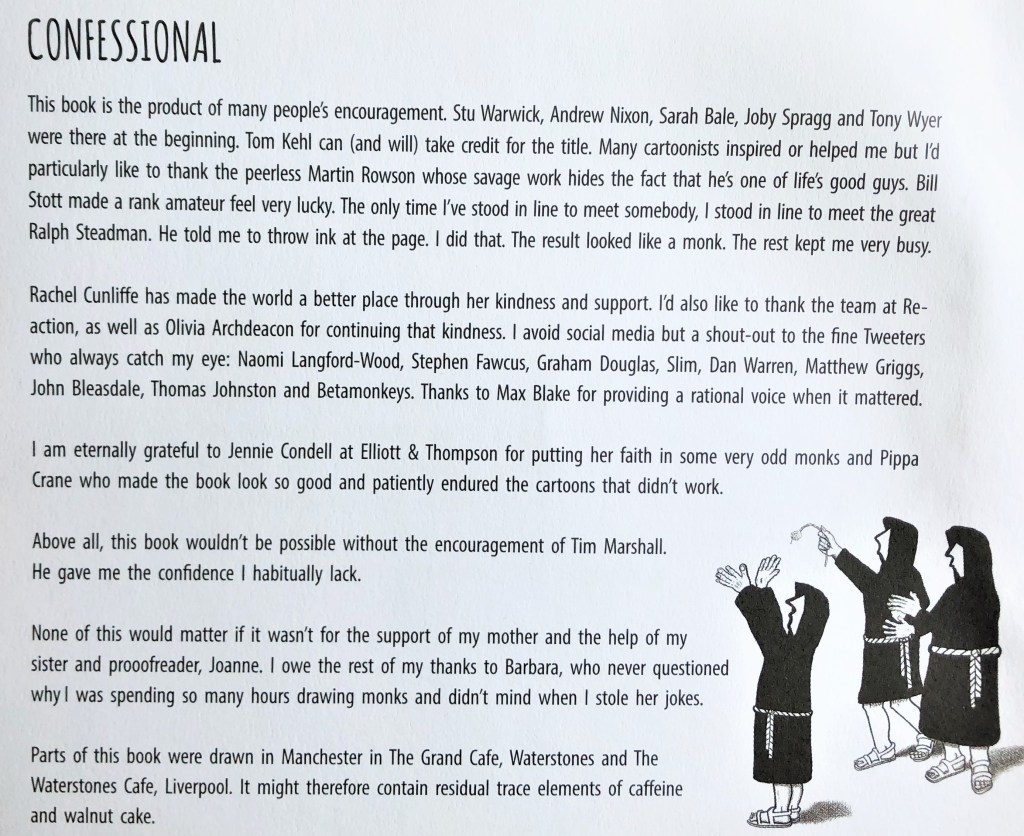
Check out the first paragraph, second line. I’m in book! I helped a friend title his excellent book of cartoons, “The Secret Lives of Monks: From Atheism to the Zombie Apocalypse.” I really only suggested the pre-colon part and he added the rest, but, as the author says below, it’s enough for me to take credit.
 Tom Kehl